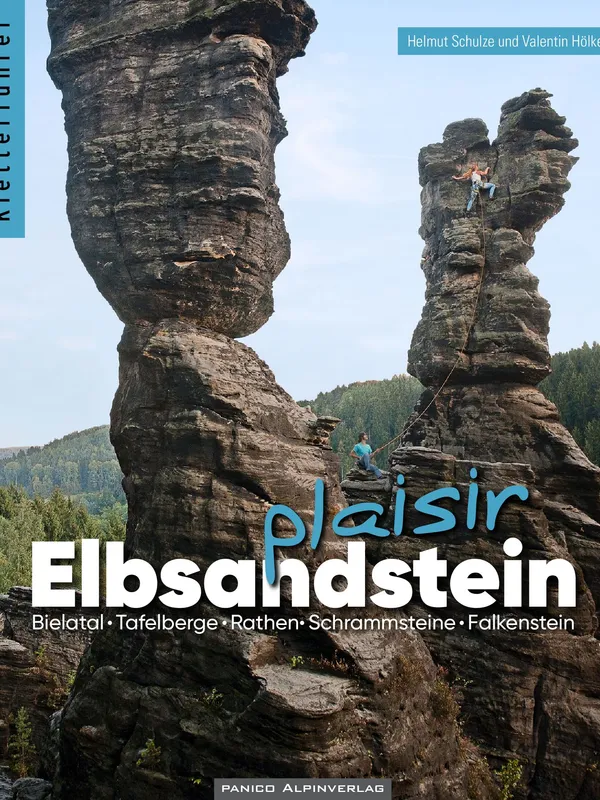
Elbsandstein Plaisir
Scope and audience
Elbsandstein Plaisir is a selective climbing guide to Germany’s Elbe Sandstone (Sächsische Schweiz), purpose-built to ease newcomers into a famously traditional area. Helmut Schulze and Valentin Hölker curate 300+ worthwhile routes, mostly in the friendly I–VII UIAA band, while explaining the region’s strict ethics (few fixed rings; no metal protection) and the craft of placing slings. The second edition expands coverage significantly with dozens of new crags and nearly 150 additional routes, and includes a code for a companion app.
Coverage and structure
The book divides the range into seven main sectors:
- Bielatal
- Tafelberge
- Rathen
- Schrammsteine
- Schmilka
- Affensteine
- Hintere Sächsische Schweiz
Each sector opens with a character sketch, driving/ÖPNV approaches, emergency notes, and clear overview maps. Individual crags begin with an info block (GPS, aspect, wall height, rappel anchors/lengths) and a succinct access description. A back-of-book register cross-references every featured pinnacle and summarizes route distribution by grade—useful when matching objectives to ability or daylight.
On the rock: topos and safety
Hölker’s topos are clean, photo-based drawings that foreground sandstone features—ribs, corners, chimneys, bands—and mark rings and rappel points without clutter. Where a full topo isn’t warranted, north-oriented plan sketches show line starts and trends. Route notes flag protection nuances and historical first ascents; the dedicated “Knotenschlingen & Co” section functions as a mini–sling school with step-by-step photos, a rare and practical inclusion for this area. Photography favors wide, context-rich images that reveal texture and movement rather than close-ups alone.
Regional flavor and selection
The selection leans toward enjoyable, well-traveled climbs: friendly short towers in Bielatal for first sandstone leads; classic airy lines around Rathen and the Schrammsteine (think Perrykante on the Tante); and scenic table mountains such as Pfaffenstein and Gohrisch. Cultural and natural-history interludes—geology, conservation, etiquette, and “Klettersächsisch”—round out the orientation.
Limitations
It’s a plaisir selective, not an exhaustive registry; harder, more serious lines are underrepresented by design. Busy hotspots are acknowledged; alternatives are present but still popular in peak season.
Verdict
Thoughtfully organized, visually lucid, and tailored to sandstone’s unique style, this guide lowers the threshold for a safe and rewarding first trip while remaining useful to returning climbers who value clear topos and smart logistics. Highly recommended as your primary Elbsandstein companion, especially when paired with the included app and a healthy respect for the local ethic.
Details
Extract- Activity
- Climbing
- Authors
- Helmut Schulze, Valentin Hölker
- Weight
- 700g
- Pages
- 464
- ISBN
- 978-3-95611-150-1
- Publisher
- Panico Alpinverlag