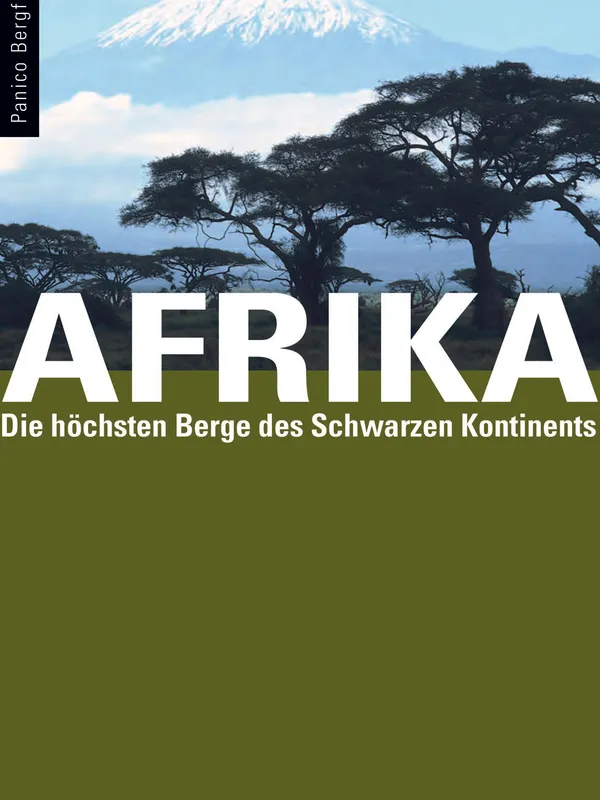
Bergführer Afrika
Scope and structure
A comprehensive mountaineering guide to Africa’s highest ranges, this volume sets out to cover every 4000‑meter peak from Morocco’s High Atlas to Tanzania’s Kilimanjaro. Beyond route descriptions, it promises practical advice for interacting with local communities, rich notes on flora and fauna, and digressions into the climbing history of the continent—an ambition it largely fulfills. The opening chapters explain how to use the guide, its grading scheme, time estimates, and mapping conventions, followed by regional sections with overview maps, then detailed peak and route entries. Helpful appendices list summits by independence, height, and alphabetically.
On‑mountain detail
For each ascent, you typically get day‑by‑day itineraries with walking times, elevation gain, and distances. The Kilimanjaro section is exemplary: geology and naming lore, a candid discussion of logistics, and multiple routes (Marangu, Machame, Umbwe, Lemosho/New Shira, Shira, Nalemoru/Rongai, Northern Circuit, plus Mawenzi). Safety notes are specific where it matters—e.g., the Western Breach calls for a helmet and confident scrambling. Similar care appears on Mount Elgon (Sasa, Sipi, Piswa, Park routes) and across the Rwenzori, where sub‑peaks on Stanley, Speke, Baker, Emin, Gessi, Luigi di Savoia, and the Portal Peaks are treated individually.
Regional coverage
- High Atlas: Toubkal group and Mgoun with clear access notes and sketch maps.
- Ethiopia: Simien and Bale ranges plus northern and southern highlands, with numerous 4,000ers like Ras Dashen, Inatye, Bwahit, Tullu Deemtu.
- Cameroon: Mount Cameroon.
- Uganda/Kenya: Mount Elgon.
- DR Congo/Uganda/Rwanda: Virunga volcanoes including Karisimbi, Visoke, Nyiragongo, Nyamulagira.
- Kenya: Mount Kenya’s Batian, Nelion, Point Lenana and many satellites.
- Tanzania: Kilimanjaro and Mount Meru.
What stands out
- Author‑drawn maps and abundant photography lend continuity and a consistent cartographic voice.
- Engaging sidebars on naming, geology, ecology, and first ascents brighten what could be purely logistical text.
- Practical clarity: time/elevation/distance triads make planning and acclimatization strategies straightforward.
Limitations
Some practical details—park fees, regulations, agency practices—inevitably date; the text itself cautions readers to verify costs, permits, and current route conditions, especially where glaciers and rockfall hazards evolve.
Recommendation
For mountaineers planning Africa’s classic high peaks—whether a single Kilimanjaro push or a multi‑range odyssey—this is a deeply researched, field‑ready companion. Use it for route selection, cultural and natural context, and on‑trail pacing, and pair it with the latest local updates for permits and access.
Details
Extract- Activity
- Mountaineering
- Authors
- Hermann Kiendler
- Weight
- 550g
- Pages
- 408
- ISBN
- 978-3-936740-76-9
- Publisher
- Panico Alpinverlag